Secrets of the Words You Know
Blog 33: PIE Voiceless Stop Consonants in non-initial position
In Blog 20, I promised you two exceptions to Grimm’s Law. We have already seen the ‘single outcomes’ for labials (Blog post 22) and palatals/velars (Blog post 27) before *s and (the much more common) *t. We now come to the second exception, which affects non-initial PIE voiceless stop consonants. It is the more significant, but also the more complex, and I have therefore left it until last. It is also the reason why – as sharp-eyed readers may have noticed – I did not offer any examples of non-initial PIE voiceless stops in the relevant blogs.
As we saw in Blog 20, Jacob Grimm argued that PIE voiceless stops evolved into Proto-Germanic voiceless fricatives, so
*p> ‘f’;
*t> ‘th’;
*k̂ and *k> ‘kh’, and then to ‘h’; and
*kʷ> ‘hʷ’.
It was clear however that there were a significant number of exceptions where a non-initial PIE voiceless stop appeared to lead to the corresponding voiced stop, so *p>b etc.
As research made scholars more convinced that there were seldom if ever ‘casual’ or random exceptions to sound changes, this class of exceptions was increasingly seen as a significant problem.
In 1876 a Danish scholar, Karl Verner, published an article that finally established a rationale for such exceptions. Here he is:
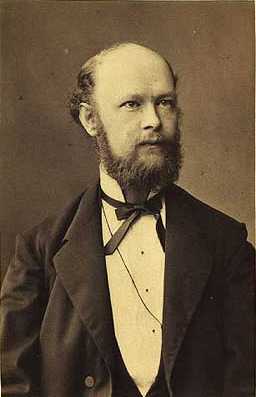
(Royal Danish Library)
Verner observed that in some German verbs a non-initial PIE voiceless consonant gave rise to BOTH a voiceless fricative and a voiced consonant in different parts of the verb, and that in these parts of the verb there was also a parallel difference in the accentuation pattern in Sanskrit. As Sanskrit appears to have largely conserved the PIE system of word-accents, he put forward the hypothesis that in Germanic the voiceless fricatives expected from PIE voiceless stop consonants under Grimm’s Law had become voiced between voiced sounds (vowels or voiced consonants on either side) if the previous syllable was not accented in PIE. This condition means among other things that such voicing does not apply to initial consonants, where there is by definition no ‘previous syllable’.
These voiced fricatives would then have merged with the voiced aspirates (*bh etc) inherited by Proto-Germanic from PIE, which had also developed into voiced fricatives, and like them developed into voiced stop consonants.
His argument was quickly accepted and is now known as ‘Verner’s Law’.
The same would apply to the one voiceless fricative inherited by Proto-Germanic from Indo-European, that is to say *s, which would develop to ‘z’ under these conditions. In turn, this ‘z’ would then have evolved to ‘r’ in the modern Germanic languages.
Here at last we can resolve the issue raised first under *r and *s about the strange-seeming alternation of ‘was’ and ‘were’ (and ‘is’ and ‘are’) in the most common verb in the English language. Both forms go back ultimately to PIE forms with an *s. Where the PIE stress fell before the *s, it would be maintained in Germanic and English (so ‘was’ and ‘is’), but where in some parts of the verb the stress fell after the *s, such instances of *s would evolve to ‘z’ and finally to ‘r’, as would have been the case at the relevant time for the verb form that gives us ‘were’ and ‘are’.
The stress patterns of all Germanic languages changed after the shift from *s>z, and are completely different from those of PIE, so that this, and the other sound-shifts under Verner’s Law, no longer had any obvious rationale. Indeed, some words have virtually lost all contact, as in ‘forlorn’ and ‘lovelorn’, the second part of which come from a now extinct ‘lorn’, originally a past participle of the verb ‘to lose’.
The replacement of ‘lorn’ by ‘lost’ is an example of ‘analogical levelling’, under which closely-related forms were often rationalised to overturn such distinctions. As one of very many examples, modern German has generalised the ‘r’ throughout its equivalent to ‘was/were’.
What all this means is that a voiced stop consonant in non-initial position in the Proto Germanic ancestor of an English word may go back either to a PIE voiced aspirate or to a PIE voiceless stop. So:
- A non-initial Proto Germanic *b (which will usually give English ‘v’, as we saw under *bh and illustrate further below) may go back to PIE*bh or *p
- A non-initial Proto Germanic *d (which regularly remains as English ‘d’) may go back to PIE*dh or *t
- A non-initial Proto Germanic *g (which also regularly remains as English ‘g’ or, if fronted, ‘y’) may go back to PIE*k̂h/kh or *k̂/*k
(The options for original labio-velars are rather more complex.)
- An ‘r’ in the same conditions can similarly go back to either a PIE *r or to an *s.
Verner’s Law not only reinforces the point made back in Blog post 10 that consonants are a more straightforward basis than are vowels for identifying links between words, but also shows that initial consonants are more straightforward than are non-initial consonants as a basis for identifying such links between Germanic languages such as English and words in or from other Indo-European languages.
We will nevertheless briefly pick out a few examples of the development of non-initial PIE voiceless stops. But first, let’s sign off on PIE *s with a nice example of an unexpected link, appropriately in the field of sound.
How Sharp is Your Hearing?
Appearing a far-fetched speculation at first sight, but actually a clear match, are the English inherited word ‘hear’ and Greek-derived ‘acoustic’.
These would appear to have nothing in common. But these words go back to two elements that are each quite well known.
There is a root *Hek̂- with the meaning of ‘sharp’. We see this in borrowings from Latin like ‘acute’ and with an r-suffix from Greek like ‘acropolis’ (the usually steep summit of a Greek city). This is thought to lie behind the first element of ‘acoustic’, and, thanks to the usual Grimm’s Law change of *k̂>h, also the ‘h’ of ‘hear’.
What’s left? Well, it seems to be the PIE root for ‘ear’ *Hous-, from which is derived ‘ear’, thanks to the evolution *s>z>r that we have just seen under Verner’s Law, as in ‘were’ in contrast to ‘was’. It also lies behind Latin borrowing ‘aural’ (regular Latin change of *s to ‘r’ between vowels) and Greek-derived ‘otology’ (regular loss of PIE *s between vowels, and a suffix including *t).
So ‘hear’ and ‘acoustic’ do have a similar origin after all, linked to an acute aural sense.
Now for the medial stop consonants.
*p in the middle or end of a word
In medial or final position, depending on where the accent would have fallen, Verner’s Law tells us that *p would give Proto-Germanic ‘f’ and so English ‘f’ or Proto-Germanic ‘b’ and so (in most cases) ‘v’.
An example of the former, the second element of the word ‘midriff’ is related to ‘corpus’, a word borrowed directly from Latin, where it means ’body’, both going back to a PIE root *kʷrep-. (We noted the loss of the initial *kʷ in Blog post 32 last week.)
There are plentiful examples of the latter. One where we can also illustrate the developments within Germanic is the PIE root *uper-. The stress would have fallen after the *p, so Verner’s Law would give Proto-Germanic *b, still reflected in our borrowing from modern German ‘Uber’, or more strictly ‘über’. In English, as we saw under *bh, this medial PGmc *b develops further to ‘v’ in most environments, as we can see in the English preposition ‘over’, inherited from the same root. A form of the root with ‘mobile *s’ (Blog post 18) gives us Latin-derived ‘super’ and Greek-derived ‘hyper’, both showing conservation of *p between vowels.
Other similar cases showing English ‘v’ reflecting a non-initial PIE *p include:
‘seven’ from *septm̥, as in ‘September’
‘harvest’ from *kerp (see matches under *k, Blog 29)
‘have’ from *kap (again, see matches under *k, Blog 29).
We can see a similar evolution in Celtic from the Welsh-derived river name ‘Avon’, where the ‘v’ goes back to a PIE *p in the root *Hep-, which is visible in the ‘Five Rivers’ of the Punjab or in the Persian ‘rose-water’ which has given us ‘Julep’.
*t in the middle or end of a word
Verner’s Law tells us that we may expect in English from PIE *t either a written ‘th’ (voiced between vowels, but unvoiced at the end of a word) or a ‘d’, depending on where the accent fell in PIE.
To get into this, do you understand understand? No, that’s not a duplicated word: do you understand why the word ‘understand’ is as it is? ‘Understanding’ clearly has some metaphorical link to standing, but standing ‘under’ something seems a very odd way of expressing comprehension. Well, it’s all the fault of Verner’s Law.
English ‘under’ has not one but two antecedents.
- For the normal sense of ‘below’ it goes back to a root * n̥dhero-, which is neatly shown in borrowings from Latin like ‘infernal’ or the Latin preposition for ‘below’, which forms the first element in ‘infrastructure’ (remember that Latin shows ‘f’ for PIE *dh). The *dh yields English ‘d’ in the usual way.
- But as we know from Verner’s Law, a non-initial ‘d’ in English might also go back to a PIE *t. There is a second PIE preposition, *Henter, which can mean ‘into’ but also ‘between’ or ‘among’, and is most readily visible in our copious borrowings from Latin which begin with ‘inter’. The PIE stress fell on the second syllable, so the *t gives English ‘d’. As a result, this word has also developed to ‘under’. It is this sense that is conserved in ‘understand’ – the idea of someone ‘standing in the middle’ and so fully engaged in the topic. We can see a similar sense in ‘an undertaking’, which neatly matches its French-derived equivalent ‘an enterprise’, where the first element derives from Latin ‘inter’.
Not surprisingly, English gradually lost the second sense, and we have had to draw on other words to cover the gap, like ‘between’ – and more recently through the direct use of the Latin counterpart in phrases like ‘the inter-war years’.
If you have fathomed that, let’s turn to ‘fathom’.
There is a PIE root *petH-, which means ‘spread out’. We can see it in borrowings from Latin like ‘expand’ (another infixed *n) or Greek-derived ‘petal’, but also important words from Latin via French around stretching out – like ‘pace’, ‘pass’ and derived forms like ‘passage’ and ‘passenger’. ‘Fathom’ is indeed from the same root (f/p yet again), and a fathom is roughly the length of two spread-out arms. So the word ‘fathom’ is an example of *t giving a fricative, as predicted by Grimm’s Law, showing that the stress at the time of the operation of Verner’s Law was on the initial syllable, as indeed it is today. One can say the same of ‘tooth’ from *dent-, the present participle of the root *Hed- discussed under *d above in Blog 24 (so ‘the biting thing’), or ‘feather’ from *pet-, as mentioned in Blog 2.
Examples where Verner’s Law yields a ‘d’ in English rather than a ‘th’ include:
‘hundred’ in contrast to ‘cent’
‘wind’ in contrast to ‘vent’
‘hide’ (meaning ‘skin’) in contrast to ‘cuticle’.
In each case I have shown a Latin-derived borrowing to illustrate that the PIE root would have shown a *t.
It’s worth pausing here on three ‘family’ names, ‘father’, ‘mother’ and ‘brother’, which help to illustrate several sound-changes:
PIE PIE Proto-Germanic Modern German Modern English
(after loss of H)
pHtér- pətér- fadēr vater father
meHtér- mātér – mōdēr mutter mother
bréHter- brā̕ter- brōthēr bruder brother
Here we can note:
- The importance of the PIE accent for the second consonant. In the third column, ‘brōthēr’, reflecting the PIE accent on the first syllable, shows the standard Grimm’s Law change of PIE *t to a Germanic fricative ‘th’, which is of course conserved in English); ‘fadēr’ and ‘mo:dēr’, with the second consonant following an unstressed syllable, show the additional Verner’s Law shift to a Germanic voiced stop.
- The fourth column shows how the Old High German Sound Shift (Blog post 9) has in turn shifted the second consonants in Modern German to a voiceless stop in ‘vater’ and ‘mutter’ (thus re-creating the position in PIE), while ‘bruder’ shows the parallel evolution of th>d.
- And in English, in a final twist shown in the last column, ‘father’ and ‘mother’ have taken part in one more shift: in Middle English final ‘-der’ changes (under certain conditions) to ‘-ther’, in effect reversing the Verner’s Law change. (Words like ‘weather’ show a similar shift.)
A ‘hidden’ example of the fate of non-initial *t is the numeral ‘four’. Here the PIE root is *kwetwōr. The PIE stress would have been on the final syllable, so the *t would give *d in Proto-Germanic *fedwōr (the initial /f/ from the *kw is anomalous, as discussed in Chapter 2 when we looked at the effect of analogy). However the sequence *dw in West Germanic languages such as English and German is simplified to *ww, and this in turn degrades between vowels so that all that is left of the *dw is the ‘u’ of the English spelling of the word, and not even that in German ‘vier’.
*k̂ and *k in the middle or end of a word
In medial and final position, Verner’s Law tells us to expect the English reflex of PIE *k̂ and *k to be based on either a Proto-Germanic *h or a *g, depending on where the PIE accent fell.
An inherited Proto-Germanic *h disappears in English between vowels. A PIE root *pek̂u seems to have originally meant ‘property’, but in some languages refers specifically to cattle, which would have been the prime store of wealth for a herding community. From this root we can compare Latin-derived words like ‘pecuniary’ and ‘impecunious’ with seemingly-remote English ‘fee’.
The same is the case before *n, as we can see from a PIE noun *tek-nom (‘child’, derived from a root *tek- meaning ‘beget or bear a child’), of which the English descendant is the near-obsolete word ‘thane’, where again the Proto-Germanic *h from PIE *k has been lost. The sense had developed from ‘child’ to the ‘follower’ of some leader, and so eventually to a Saxon squire or a Scottish nobleman as in ‘The Thane of Fife’.
Following an *r, the *h remains just visible as a second ‘r’ in the spelling of ‘farrow’, which we noted under *p descends, like French borrowing ‘pork’, from the PIE word *pork̂os (‘young pig’) that we met in ‘Orkney’.
There are also roots where, under Verner’s Law, a medial *k̂ or *k gives a Proto Germanic *g, which can develop through fronting into a ‘y’ or, as mentioned under *gh, a ‘w’. Two examples of the latter are ‘saw’ from a root *sek- (to cut) and ‘tow’ from the root *deuk- that we noted under *d.
*kʷ in the middle or end of a word
As we noted under *ĝ/g, Proto-Germanic shifts all velars to *h before *s and *t, usually appearing in English as a written ‘gh’, but lost in speech. An example from a PIE root with a *kʷ in it is *nekʷt-, the root that yields English ‘night’.
Except in those cases Verner’s Law will apply, and we can expect that in Proto-Germanic, *kʷ in non-initial position will give either *hw or *gʷ in Proto-Germanic.
Let’s look at an example of each.
First, Proto-Germanic *hw.
The PIE root *sekʷ – (‘to follow’) develops a variety of meanings. As your ‘followers’ are your allies, Latin uses the word from this root that we have borrowed as ‘social’ to refer to allies (a particularly brutal war between the Romans and many of their Italian neighbours is quaintly termed ‘The Social War’ in consequence) or to groups. But in several Indo-European language groups, including Germanic, the same root gives rise to words around ‘seeing’, probably with the idea of ‘following with one’s eyes’. (Some authorities argue that the roots should be regarded as distinct, though identical in form, because of the divergence of meaning.) The PIE stress would have fallen on the first vowel, thus yielding Proto-Germanic *hw. In Old English, as we saw with ‘sing’ under *gwh, ‘w’ is lost after non-initial velars, including ‘h’. The ’h’ thus found itself between two vowels, and was subsequently lost, as usual in such a position, giving English ‘see’. By contrast, German, which similarly lost ‘w’ after non-initial velars, still shows the ‘h’ in ‘sehen’.
Second, Proto-Germanic *gʷ:
The PIE root *Hokʷ- means just the same as its English descendant ‘eye’. In this case, the accent in PIE would have fallen on the ending of the word (ie after the kʷ). As a result, Verner’s Law would have yielded a Proto-Germanic word with *gʷ, the labial then being lost under the rule we saw with ‘sing’ under *gʷh. The English ‘y’, as often, is the relic after fronting of the resulting *g. It’s another case where the outdated spelling of English is helpful in understanding the origin of a word in a way that the phonetic rendering ‘ai’ would not be.
This root is also the origin of copious ‘eye’-related words from
- Old Norse (‘window’, literally ‘wind-eye’ from ‘vind-auga’ – note the conservation of Proto Germanic *g and its subsequent change to ‘w’ as with ‘saw’ and ‘tow’ above);
- Latin (‘ocular’ and similar words, including ‘inoculate’ originally from grafting the ‘eye’ or bud of one plant into another);
- Greek (‘optical’ and its many derivatives like ‘myopia’ and ‘autopsy’).
When you see in English an alternation in ‘learned’ words between a hard ‘c’ and a ‘p’ you can be pretty confident that both go back to a labio-velar, and that the words with the hard ‘c’ are borrowed from Latin and those with ‘p’ from Greek.
We can note here a classic example of a subtle difference between *kʷ and *kw which we mentioned at the start of the section on labio-velars. We start from the PIE word for horse, *ek̂wo-, which gives us via Latin our words like equine and equestrian. On their own, those words could have come from a root either with *kʷ (*ekʷo-) or with *kw (*ek̂wo-). But Indian names like ‘Ashwin’ (literally ‘horse-owner’) can derive only from *ek̂wo-, where the *k̂ would give the sound ‘sh’ in Sanskrit. (A *kʷ would have resulted in either a ‘k’ or if fronted a fricative ‘ch’. The double ‘p’ in the Greek word for ‘horse’, which forms the first part of the name of the ‘river horse’ or ‘hippopotamus’, is further confirmation that the sounds *kʷ and *kw must have been distinct in PIE, as kʷ would have given just a single ‘p’ in Greek.
We will finish with another word that shows that not everything in language works out as one might expect. A very widely-shared word across Indo-European groups is *wl̥kʷos, meaning ‘wolf’ (except in the Anatolian languages, where it means ‘lion’). Here both Latin and Germanic have unusual derivatives.
In Latin, the word for ‘wolf’ is visible directly in the disease ‘lupus’, so-called because of its tendency to produce facial lesions which were thought by Mediaeval doctors to resemble wolf-bites. As with ‘ocular’ above, we would expect Latin to show a velar, rather than the labial ‘p’. It seems clear that the Romans borrowed a ‘wolf’ word from another Italic language or dialect, just as they did with the word for ‘cow’ (discussed under*gʷ above). It is normal, for example, for inherited labio-velars to become labials in now extinct Italic languages like Oscan and Umbrian.
In Germanic, there is a similar issue. The ‘f’ of the English word, which is also visible in German ‘Wolf’, is unexpected. As the stress is on the first syllable, the *kʷ would have been expected to yield Proto-Germanic *hw, and eventual loss in English. Discussion still continues on how this case should be assessed, some arguing that as a wolf was hunted its name might have been subject to a taboo that might have affected its pronunciation.
Well, it’s been a long Blog post, but I still owe you one final ‘root-test’. This will be about a root providing a non-initial *kʷ. Suitably for a final question, it is not the hardest test for you.
What’s an inherited English word from another PIE root whose second consonant is *kʷ?
We looked just now at a root *sekʷ-, meaning ‘to follow’, which might also be the origin of words about ‘seeing’, though with some arguing that that the difference in meaning was such that we should accept two roots with identical phonetic shape. There is also a definitely separate *sekʷ-, with a different accentual pattern and a different meaning. Your task is to identify an English verb descended from it, which also provides what seems to be the core meaning of the root.
You have two clues:
- the PIE accent fell after the *kʷ (unlike the otherwise identical root for ‘to follow’), so under Verner’s Law, the *kʷ would have given Proto-Germanic *gʷ and therefore a modern German ‘g’, as German loses the ‘w’ element after a velar. In English, this could either survive as ‘g’ or shift to a ‘i’ or ‘y’.
- words from the same root give us Old Norse borrowings including ‘saga’, ‘scold’ and ‘skald’ (the Old Norse word for a poet, mentioned in Blog post 6), and an archaic inherited English term that we find only in the stock phrase ‘an old saw’ (in the sense of a proverb).
What’s the verb?